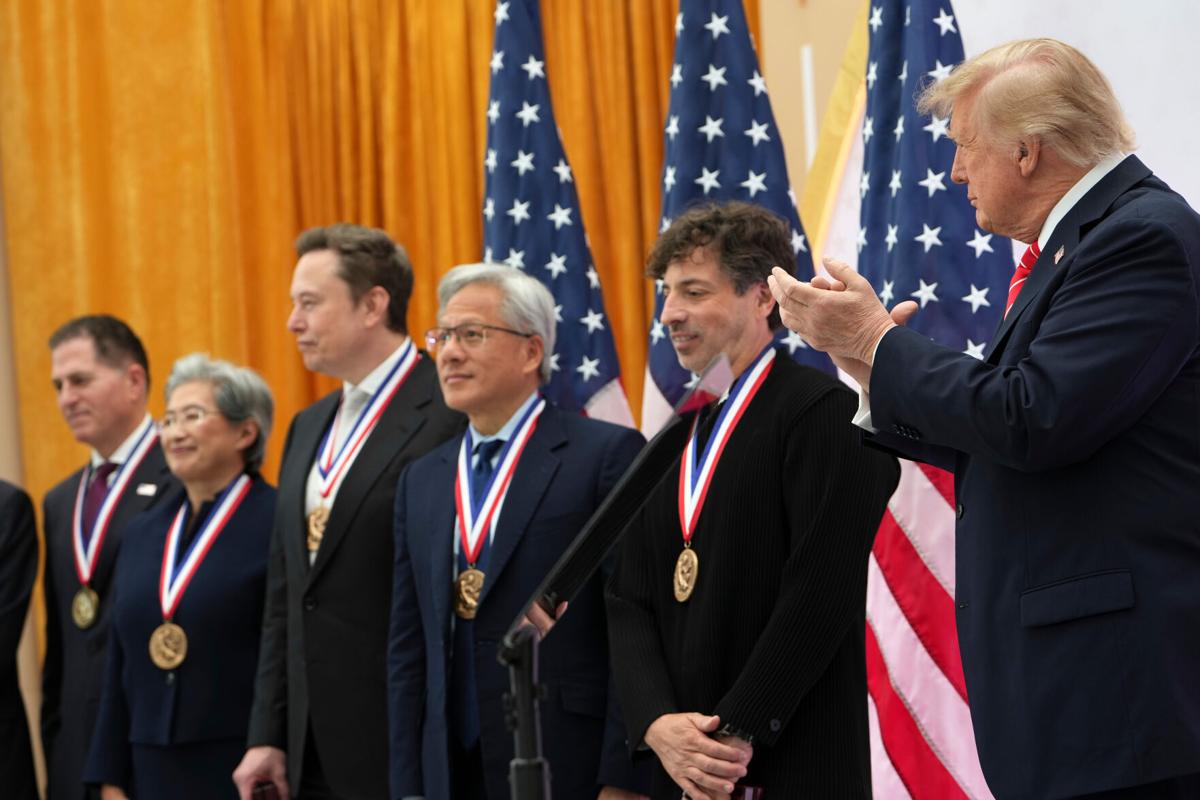
Six prominent technology leaders received major US national honours on October 8, as President Donald Trump used a White House-hosted summit to recognise achievements in science, engineering and innovation.
Elon Musk, Nvidia chief Jensen Huang, Google co-founder Sergey Brin and AMD CEO Lisa Su received the National Medal of Science. Microsoft CEO Satya Nadella and Dell Technologies founder Michael Dell were awarded the National Medal of Technology and Innovation.
The ceremony took place during the administration’s Science: A New Golden Age summit, which highlighted the role of technological development and private-sector investment in maintaining American leadership.
However, the awards also drew attention to financial connections between the technology sector and the Trump administration, as well as a separate government decision affecting Microsoft's ability to sponsor foreign workers for permanent residency.
What the Six Technology Leaders Were Recognised For
The awards recognise achievements across science, engineering and technology, including advances that underpin modern computing and communications.
Musk was recognised for engineering and technological work spanning space exploration, intelligent systems and communications. Brin was honoured for contributions to information retrieval and data processing, while Huang's work has helped advance graphics processing and parallel computing. Su was recognised for contributions to semiconductor engineering and high-performance computing.
The National Medal of Technology and Innovation recognised Dell's role in expanding personal and enterprise computing, alongside Nadella's leadership at Microsoft, particularly in cloud computing and digital infrastructure.
These fields are central to the modern technology economy. Advanced processors help power artificial intelligence systems, while cloud platforms provide the computing infrastructure used by businesses, governments and consumers.
Trump praised the recipients for helping advance America's technological future, presenting their achievements as part of a broader effort to strengthen the country's global position.
Donations Put Political Connections Under the Spotlight
The ceremony also brought renewed attention to financial relationships involving technology companies, their leaders and initiatives associated with Trump.
A report by The New Republic, cited by TechCrunch, highlighted donations and financial commitments connected to the awardees, their companies and the administration. These included corporate contributions to Trump's inauguration fund and the proposed White House ballroom, as well as AMD's reported contribution to a pro-Trump political action committee.
Michael Dell and his wife, Susan Dell, separately pledged $6.25 billion to support Trump Accounts, a government-backed savings initiative for children.
These financial commitments involve different forms of support, including corporate donations, political spending and philanthropic pledges. They should not automatically be interpreted as personal donations by every award recipient.
The connections have prompted questions about the relationship between political influence and recognition of private-sector achievements. However, the existence of donations does not, by itself, establish that the awards were granted in exchange for financial support.
The White House has presented the medals as recognition of contributions to science, engineering and American technological development.
Microsoft's Immigration Dispute Adds Another Layer
Nadella received his award amid a government action affecting Microsoft's participation in the PERM programme, which employers generally use to sponsor eligible foreign workers for permanent residency in the United States.
PERM is separate from the H-1B visa programme, which allows US employers to hire eligible skilled foreign workers temporarily.
Vice President JD Vance accused Microsoft of replacing American workers with foreign employees, pointing to layoffs and the company's use of employment-based immigration programmes. Microsoft disputed the administration's characterisation, saying most of its US workforce is American and that many of its immigration applications concern existing employees.
The timing placed the government's recognition of Nadella's technology leadership alongside a dispute over how major technology companies recruit and retain international talent.
The issue extends beyond Microsoft. Technology companies depend on specialised workers in areas such as cloud computing, semiconductor engineering and artificial intelligence. At the same time, US policymakers continue to debate how immigration rules should protect domestic employment while supporting innovation and economic growth.
The awards ceremony highlighted the influence of major technology companies on America's scientific and economic development. Yet the questions surrounding political donations and immigration policy show that the relationship between Washington and Big Tech extends beyond technological achievement.
How governments recognise innovation, regulate access to international talent and manage relationships with major corporations will remain important issues as competition in artificial intelligence, semiconductors and other strategic technologies intensifies.