
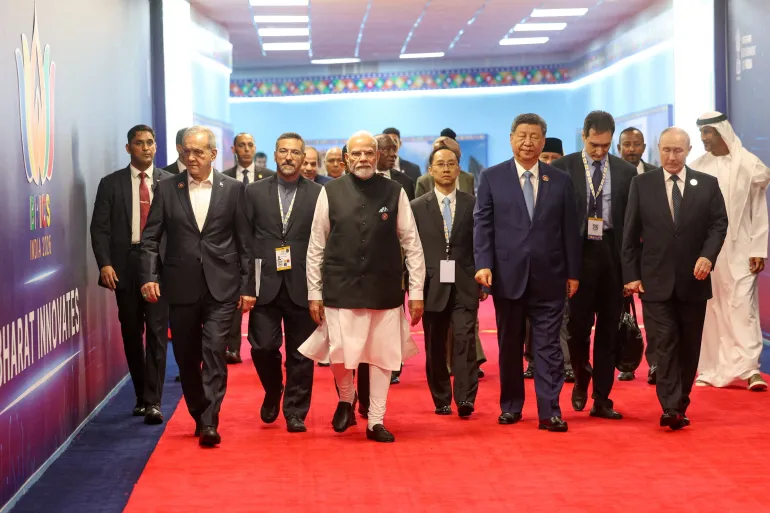
The 18th BRICS summit in New Delhi has highlighted both the growing influence of the emerging-market bloc and the difficulties created by its expansion.
Leaders from the 11-member group met in India as the war involving Iran continued to dominate the wider geopolitical environment. The summit produced a joint declaration calling for maximum restraint in the Middle East and warning against actions that could further intensify the crisis. The statement also expressed concern about attacks on civilians and civilian infrastructure and called for diplomatic approaches to international conflicts.
However, the carefully balanced language also revealed the difficulty of building a common geopolitical position among countries with very different national interests.
THE IRAN TEST
The conflict has become an important test for BRICS because several of its members are directly connected to the Middle East crisis in different ways.
Iran is itself a BRICS member, while the United Arab Emirates is also part of the expanded group. Their security interests in the region are not always aligned, making a strong unified position on the conflict difficult.
Earlier in May, BRICS foreign ministers failed to produce a joint statement on the Iran war after disagreements over how the conflict should be described. Iran had pushed for stronger criticism of the United States and Israel, while other members were reluctant to adopt language that ignored their own security concerns.
By September, however, members managed to reach a compromise. Iran and the UAE both supported a joint declaration urging restraint, demonstrating that BRICS can still find common ground even when its members have conflicting regional interests.
The result was significant, but it also demonstrated the limits of the organisation. BRICS was able to agree on diplomatic principles, but not necessarily on a detailed collective strategy for dealing with the conflict.
AN EXPANDED BRICS FACES MORE INTERNAL DIFFERENCES
BRICS has changed considerably from the original grouping of Brazil, Russia, India, China and South Africa.
The expanded organisation now has 11 members, including Egypt, Ethiopia, Indonesia, Iran and the UAE. It also works with additional partner countries from different regions. The expansion has given BRICS a much broader geographic and economic footprint.
But expansion has created a new challenge.
Every additional member gives BRICS more economic resources, diplomatic connections and representation across the Global South. At the same time, every member brings its own foreign-policy priorities, security concerns and relationships with major powers.
The Iran-UAE relationship illustrates the problem particularly well. Both countries can participate in the same organisation while having different views about regional security.
This means that BRICS is unlikely to behave like a traditional military or political alliance where members are expected to automatically support one another during international crises.
INDIA DOES NOT WANT AN ANTI-US ALLIANCE
India's position is central to understanding BRICS' cautious approach.
New Delhi has promoted BRICS as a platform for a more balanced and multipolar international system, but it has not treated the organisation as an alliance designed specifically to oppose Washington.
India maintains important economic, defence and strategic relationships with the United States and other Western countries while simultaneously maintaining major relationships with Russia and China.
This gives New Delhi strategic flexibility.
An openly anti-American BRICS could therefore create problems for India by forcing it to choose between relationships that it currently tries to maintain simultaneously.
The 2026 summit also demonstrated India's attempt to manage its complicated relationship with China. Indian Prime Minister Narendra Modi and Chinese President Xi Jinping held talks on the sidelines of the summit as both countries sought to stabilise relations after years of tensions, particularly over their disputed border.
RUSSIA AND CHINA HAVE DIFFERENT PRIORITIES
Russia views BRICS as an important mechanism for reducing the effects of Western economic pressure and strengthening relationships outside the traditional Western sphere.
For Moscow, greater cooperation among emerging economies can create alternative economic and diplomatic channels.
China has an even broader ambition.
Beijing wants BRICS to contribute to a more multipolar international system and reduce the structural advantages enjoyed by Western countries in areas such as global finance, trade and international institutions.
At the 2026 summit, Xi promoted deeper cooperation in areas including artificial intelligence, trade, finance and political coordination. China also announced initiatives intended to strengthen economic cooperation across the expanded BRICS network.
However, China also has substantial economic links with the United States and the wider global trading system. Turning BRICS into a permanent confrontation mechanism against Washington could therefore work against some of China's economic interests.
BRICS IS MORE THAN A GEOPOLITICAL ALLIANCE
The biggest misunderstanding about BRICS may be expecting it to function like NATO.
BRICS is primarily a political, economic and diplomatic cooperation framework. Its members do not have identical foreign policies, military commitments or strategic objectives.
Where the countries can agree, cooperation can be significant.
The New Delhi Declaration supports greater participation by developing countries in global decision-making and calls for reforms to international institutions, including the United Nations system. BRICS members also support stronger South-South cooperation and greater representation for emerging and developing economies.
The bloc is also working on practical economic issues, including local-currency trade, cross-border payment systems, development finance, energy security, food security, technology and supply-chain resilience.
These areas may ultimately have a greater long-term impact than dramatic political statements.
THE DOLLAR QUESTION
One of BRICS' long-term ambitions has been to reduce excessive dependence on Western financial infrastructure.
The group has discussed increasing the use of national currencies in trade and improving cross-border payment mechanisms.
However, moving away from the US dollar is considerably more complicated than simply announcing a new currency or payment system.
The dollar remains deeply embedded in international trade and finance, while BRICS members have different financial systems and economic priorities.
Consequently, the more realistic approach may be gradual diversification rather than an immediate attempt to replace the dollar.
ECONOMIC WEIGHT DOES NOT AUTOMATICALLY CREATE POLITICAL UNITY
BRICS' growing size gives the organisation considerable potential.
The expanded bloc represents a large share of the world's population and includes major energy producers, manufacturers, agricultural economies and rapidly growing markets.
But economic weight alone does not guarantee geopolitical unity.
Brazil may prioritise development and greater representation for the Global South. India emphasises strategic autonomy. China seeks a larger role in reshaping global governance. Russia wants stronger alternatives to Western economic pressure. Middle Eastern members have their own regional security priorities.
These objectives overlap in some areas but diverge in others.
The Iran war has therefore exposed a fundamental tension: BRICS can become more influential without necessarily becoming more politically unified.
THE “POLYCENTRIC” CHALLENGE
The organisation's diversity can be viewed as both its greatest advantage and its biggest weakness.
Because BRICS includes countries from Africa, Asia, the Middle East and Latin America, it can present itself as a broader platform for the Global South.
That diversity gives the bloc legitimacy when it calls for reforms to international institutions and greater representation for developing countries.
But the same diversity makes unified geopolitical action harder.
The more countries BRICS brings together, the more national interests have to be reconciled before the organisation can take a strong collective position.
This explains why BRICS may be more effective as a bargaining and cooperation platform than as a single geopolitical bloc.
THE IRAN WAR MAY ALSO REVEAL A STRENGTH
The inability to agree on every geopolitical issue does not necessarily mean BRICS is failing.
In fact, avoiding a rigid alliance structure could help the organisation survive disagreements among its members.
The September declaration showed that countries with conflicting interests could still agree on broad principles such as diplomacy, restraint, opposition to unilateral measures and the importance of international cooperation.
That flexibility may become one of BRICS' most important characteristics.
Instead of trying to replace the existing international system overnight, the bloc can gradually seek greater influence within it.
That could involve strengthening alternative development institutions, increasing trade among developing countries, improving payment systems, supporting local currencies and demanding greater representation for emerging economies in institutions such as the IMF, World Bank and United Nations.
WHAT COMES NEXT FOR BRICS?
The next stage will test whether the bloc can convert its declarations into practical results.
India handed the BRICS chairmanship to China for 2027, giving Beijing an opportunity to shape the group's next agenda.
China is expected to place considerable emphasis on economic cooperation, technology, finance and the expansion of BRICS' role in global governance.
The challenge will be maintaining cooperation without allowing disagreements among members to undermine the organisation.
CONCLUSION
The Iran war has revealed an important reality about BRICS.
The organisation has growing economic resources, a wider geographic reach and increasing diplomatic importance. But those advantages do not automatically translate into a unified geopolitical strategy.
BRICS can agree on many broad goals, including a more representative global order, stronger South-South cooperation, expanded economic ties and greater strategic autonomy for developing countries.
The difficult question is what happens when those countries are confronted with a specific international crisis in which their interests collide.
For now, the evidence suggests that BRICS is more likely to reshape the global balance gradually than to emerge as a single anti-US geopolitical bloc.
Its greatest influence may therefore come not from confronting the existing system directly, but from creating more economic, diplomatic and strategic choices for countries outside the traditional Western power structure.