A NEW REPORT PUTS THE WEST BANK UNDER THE SPOTLIGHT
A new report from Israeli human rights organisation B’Tselem has reignited international debate over the future of Palestinians in the occupied West Bank.
Published on September 14, 2026, the report, titled The Elimination Project, argues that the growing number of raids, demolitions, settlement expansions, movement restrictions and attacks on Palestinian communities should not be viewed as unrelated incidents.
Instead, B’Tselem says they form interconnected parts of a broader system that is weakening Palestinian communities while expanding and entrenching Israeli control over the territory.
The organisation describes the current period as an accelerated phase of a much longer process. Its analysis is based on roughly 2,000 Palestinian testimonies alongside field research and years of documentation.
FIVE PRESSURES WORKING AT THE SAME TIME
At the centre of B’Tselem’s report is the argument that Palestinian life is being affected on several fronts simultaneously.
The organisation identifies five interconnected areas: violence and intimidation, restrictions on movement, economic pressure, destruction of social and political structures, and what it describes as ethnic cleansing and territorial takeover.
The significance, according to the report, is not simply the existence of individual abuses. It is the way different policies can reinforce one another.
A family facing violence may struggle to remain on its land. Road closures can make employment, education and medical treatment more difficult. Economic restrictions can weaken livelihoods, while displacement can further fragment communities.
B’Tselem argues that the combined effect is to make ordinary Palestinian life increasingly unstable and dependent.
FROM INDIVIDUAL INCIDENTS TO A WIDER PATTERN
Recent events illustrate why the report has attracted attention.
In early September, two Palestinian teenagers were killed during violence in al-Mughayyir, east of Ramallah. Around the same period, demolitions and displacement affected Palestinian communities in the southern West Bank, while residents of Qusra reported an extended confrontation involving Israeli settlers.
These incidents occurred in different places and under different circumstances.
B’Tselem's argument is that looking at them individually can obscure the wider picture.
The organisation says the repeated combination of violence, displacement, restrictions and settlement expansion is helping transform the geography of the West Bank and making some Palestinian communities increasingly difficult to sustain.
MOVEMENT RESTRICTIONS CAN CHANGE EVERYDAY LIFE
One of the report's major areas of concern is freedom of movement.
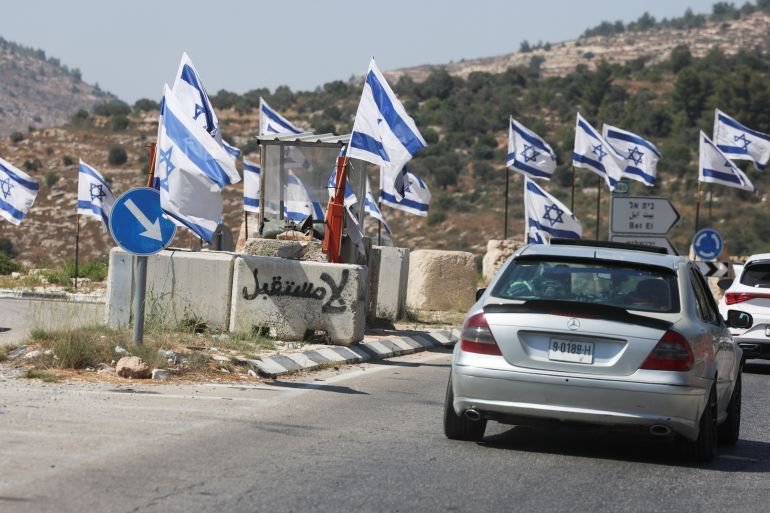
Road closures, checkpoints, gates and other restrictions can affect whether Palestinians can reach workplaces, schools, universities, hospitals, agricultural land and relatives.
The Guardian's reporting on the B’Tselem study documented a recent example involving a Palestinian father carrying his daughter around a roadblock after a gate providing access to their village was closed.
For B’Tselem, such restrictions are important because they do not merely affect travel. They can interfere with the basic routines through which a community functions.
THE ECONOMIC PRESSURE IS ALSO GROWING
B’Tselem describes what it calls “economic strangulation” as another major component of the process.
The report points to restrictions affecting employment, agriculture, infrastructure, resources and Palestinian institutions.
The economic consequences are significant. The West Bank unemployment rate rose from 13.1 percent in 2022 to 31.3 percent in 2024, according to figures cited in the report.
B’Tselem also says large numbers of Palestinian work permits have been cancelled, placing additional pressure on families whose incomes depend on employment.
The report argues that economic vulnerability can make communities less capable of resisting displacement or maintaining essential public services.
SETTLEMENT EXPANSION CHANGES THE MAP
Settlement expansion is another central element of the report.
Reuters recently documented the rapid development of Israeli settlement outposts in the West Bank, including the use of prefabricated buildings and agricultural activity to establish new sites.
Reuters reported that settlers founded 184 unauthorised outposts during the three years ending in 2025, according to Peace Now, nearly matching the number established during the previous three decades.
The Israeli government disputes many international characterisations of settlement activity, while most of Israel's Western allies regard the settlements as illegal under international law.
B’Tselem argues that the continued expansion of settlements and outposts gradually fragments Palestinian territory while creating a more permanent Israeli presence.
THE ROLE OF BEZALEL SMOTRICH
B’Tselem's report places particular emphasis on Finance Minister Bezalel Smotrich and a political document he published in 2017 known as the “Decisive Plan.”
According to B’Tselem, the plan presented Palestinians with three broad choices: accepting Jewish supremacy while abandoning national aspirations, leaving the territory, or facing violent suppression if they resisted.
The organisation argues that elements of this thinking have increasingly influenced government policy.
This interpretation is strongly political and contested, but the report says the document provides an important framework for understanding current settlement and annexation policies.
A DEEPER STRUGGLE OVER WHO CONTROLS THE LAND
The dispute is ultimately about more than individual settlements or military operations.
B’Tselem argues that the long-term transformation of the West Bank is creating a situation in which Palestinian communities become increasingly fragmented while Israeli settlements and infrastructure become more interconnected.
Reuters has separately reported that Israeli officials and settler organisations are pursuing what some describe as “practical sovereignty” over parts of the West Bank.
The Israeli government says settlement development is connected to Israel's security, historical claims and national interests, while Palestinian officials and rights organisations argue that continued expansion threatens the possibility of an independent and geographically connected Palestinian state.
THE HUMAN COST EXTENDS BEYOND LAND
B’Tselem's report also focuses on the social consequences.
When communities are displaced or isolated, the effects can reach schools, healthcare, employment, family networks, cultural institutions and local organisations.
The report says Palestinian civil-society groups have faced raids, closures, arrests and other restrictions since October 2023.
It argues that dismantling these institutions can weaken the ability of Palestinian communities to organize, provide services and maintain social connections.
WHY THE REPORT MATTERS NOW
The report comes at a particularly sensitive moment.
International pressure over West Bank settlement expansion and settler violence has been increasing, while several Western governments have taken stronger positions against settlement activity.
The United Kingdom recently announced measures targeting goods and services connected to Israeli settlements and accused settlers of contributing to ethnic cleansing, a characterisation strongly rejected by Israel.
Against this background, B’Tselem's report adds another detailed Israeli human-rights perspective to an increasingly international debate over the future of the West Bank.
A CONFLICT OVER THE FUTURE OF THE WEST BANK
The central warning from B’Tselem is that Palestinian displacement should not be understood only through individual demolitions, attacks or arrests.
The organisation argues that the deeper issue is the cumulative effect of policies that influence where Palestinians can live, how they move, how they earn money, whether they can access services and whether their communities can remain intact.
Israel rejects many of the accusations made by Palestinian rights organisations and maintains that its policies are driven primarily by security concerns and national interests.
But B’Tselem's report has put a much broader question back at the centre of international attention: Is the West Bank moving toward permanent territorial fragmentation, or can a viable Palestinian society and state still be preserved?
WHAT HAPPENS NEXT?
The report is likely to intensify pressure on Israel over settlement expansion, displacement and the treatment of Palestinians in the occupied West Bank.
It could also become part of a wider international debate over annexation, Palestinian statehood and the future of the two-state solution.
For Palestinians living across the West Bank, however, the issue is much more immediate.
It concerns whether they can remain on their land, travel to work and school, access healthcare, maintain their livelihoods and preserve the communities they have built over generations.
CONCLUSION
B’Tselem's Elimination Project presents the West Bank not as a series of disconnected crises, but as what the organisation describes as an interconnected system of pressure on Palestinian collective life.
Whether one accepts all of B’Tselem's political conclusions or not, the report provides a major new examination of how settlement expansion, violence, economic restrictions, movement controls and displacement are reshaping the occupied West Bank.
Its publication ensures that the question of what happens to Palestinian life — and who ultimately controls the territory — will remain at the centre of international debate.