NATO DRAWS A HARDER LINE AFTER STRIKE NEAR POLAND
NATO has vowed to strengthen its support for Ukraine after a Russian drone struck a passenger train close to the Polish border, triggering fresh fears that the war could increasingly spill toward NATO territory.
NATO Secretary-General Mark Rutte said on Monday that Russia would not succeed in intimidating Western governments into abandoning Ukraine.
The incident has already prompted Poland to increase security along its border while European officials warn that attacks so close to NATO territory represent a serious escalation.
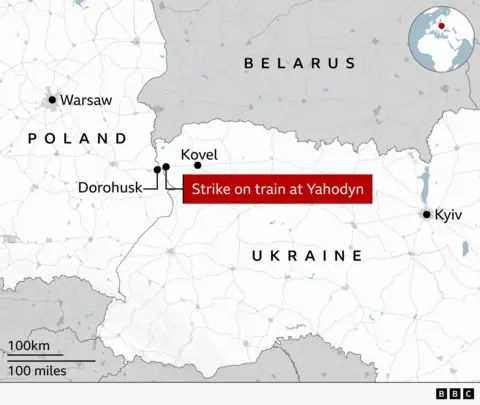
The train strike occurred on Sunday near Yahodyn, only about 2km from Poland.
A DIPLOMATIC TRAIN HAD PASSED MINUTES EARLIER
The attack has attracted particular attention because a diplomatic train carrying former British Prime Minister Boris Johnson, former Swedish Prime Minister Carl Bildt and European security officials had passed through the same area shortly beforehand.
Ukraine's state railway operator said the diplomatic train had left the station earlier than originally planned because of changing security conditions.
Ukrainian officials said it was possible the earlier diplomatic train had been the intended target, although that has not been independently established.
The passenger train that was struck was evacuated and no casualties were reported.
RUTTE SAYS NATO WILL NOT BE INTIMIDATED
Speaking in Brussels, Rutte described the Russian attacks as evidence of growing recklessness and said Moscow would not force NATO countries to retreat from their support for Kyiv.
The NATO chief also said the alliance would strengthen its own defences along its eastern flank.
His message was clear: attacks close to NATO territory will not automatically produce the political effect Moscow may want.
Instead, Western governments are signalling that such incidents could lead to greater military preparedness and continued assistance to Ukraine.
POLAND MOVES TO STRENGTHEN ITS DEFENCES
Poland has responded to the incidents by increasing security along its border with Ukraine.
Prime Minister Donald Tusk warned that Russia could intensify operations near Ukraine's western frontier and said Poland could not rule out the possibility that the conflict might eventually affect its own territory.
Warsaw is now consulting NATO allies about how to respond to the growing security risks.
The concerns extend beyond the railway attack.
A SUSPECTED RUSSIAN DRONE WAS FOUND OFF POLAND'S COAST
Polish Defence Minister Wladyslaw Kosiniak-Kamysz announced on Monday that the country's military had recovered what authorities believe was a Russian military drone from the Baltic Sea coast.
The discovery comes at a particularly sensitive moment, adding another layer to Poland's concerns about possible Russian activity around its territory.
Reuters reported that the drone was found near Poland's northern coastline.
Polish authorities have not publicly established all details surrounding how or why the drone ended up there.
EUROPE SAYS FEAR MUST NOT CHANGE ITS UKRAINE POLICY
EU foreign-policy chief Kaja Kallas said the attacks near Poland appeared intended to frighten Western countries away from supporting Ukraine.
Her message echoed Rutte's position: European governments should demonstrate that Russian attacks will not determine whether they continue backing Kyiv.
French Foreign Minister Jean-Noël Barrot also described the train strike as an attempt to intimidate and divide European countries.
The incident has therefore become about more than a single damaged train. It has become another test of European political unity.
MOSCOW SAYS ITS OPERATIONS WILL CONTINUE
Kremlin spokesman Dmitry Peskov defended Russia's ongoing military campaign, saying Russian forces were operating throughout Ukraine and would continue doing so.
Russia has not accepted the Western interpretation that the train incident was designed specifically to intimidate NATO governments.
That leaves Europe facing an increasingly difficult security environment in which attacks close to its borders can quickly become major diplomatic flashpoints.
TRUMP CLAIMS RUSSIA AND UKRAINE HAVE AGREED ON AN ENERGY TRUCE
While NATO was promising stronger support for Ukraine, Donald Trump introduced another dramatic development into the situation.
The US president said Russia and Ukraine had agreed not to attack each other's energy infrastructure.
Trump said Ukraine had agreed to stop targeting Russian energy facilities and claimed Russia had agreed to do the same.
However, neither Moscow nor Kyiv had independently confirmed a formal agreement matching Trump's statement.
That distinction is important because the proposed arrangement could represent a significant de-escalation, but its actual terms and implementation remain unclear.
ZELENSKYY OFFERS A POSSIBLE PATH TOWARD DE-ESCALATION
Ukrainian President Volodymyr Zelenskyy said Kyiv was prepared to halt strikes against Russian territory if its international partners could secure assurances that Russia would stop attacking Ukrainian energy facilities, infrastructure and food-supply routes.
Zelenskyy described such a move as potentially representing a first step toward peace.
Reuters reported that Ukraine wants concrete details and guarantees from its partners before committing to such a pause.
The Kremlin, meanwhile, has continued to demand broader concessions from Kyiv as a condition for ending the war.
WHY ENERGY INFRASTRUCTURE HAS BECOME A MAJOR BATTLEGROUND
Energy facilities have become one of the most important targets in the wider conflict.
Ukraine has increasingly attacked Russian oil-refining infrastructure, while Russia has repeatedly targeted Ukrainian energy facilities.
The consequences are not limited to the battlefield.
Damage to refineries, pipelines and power infrastructure can affect fuel supplies, transportation costs and energy prices far beyond Ukraine and Russia.
Trump has recently focused particularly heavily on rising diesel prices in the United States, linking fuel-market pressure to the war.
THE TRAIN ATTACK HAS CHANGED THE SECURITY CONVERSATION
For European governments, the location of the latest strike is what makes it particularly sensitive.
The attack occurred extremely close to Poland, a NATO member whose eastern frontier has become one of the alliance's most closely watched security zones.
A direct attack on NATO territory could trigger a far more serious confrontation.
That is why European officials are treating incidents near the border as potential warning signs rather than isolated battlefield events.
A WIDER FEAR OF ESCALATION
Polish officials have warned that Russia could increase sabotage operations and other activities inside European countries as part of an effort to weaken Western support for Ukraine.
Such warnings have intensified concerns about critical infrastructure, transport networks and border security.
At the same time, European governments are trying to avoid overreacting to individual incidents in ways that could create an even wider confrontation.
The challenge is to strengthen deterrence without allowing the conflict to spiral beyond Ukraine.
NATO FACES A DIFFICULT BALANCE
The alliance now faces two competing pressures.
On one side, NATO wants to make clear that Russia cannot intimidate its members or weaken support for Ukraine through attacks near European borders.
On the other, NATO countries have a strong interest in preventing a direct military confrontation between the alliance and Russia.
That makes every incident close to NATO territory politically significant.
The train strike is therefore likely to remain part of a much larger discussion about how far Russia is prepared to push and how far Europe is prepared to respond.
THE ROAD TO PEACE REMAINS UNCERTAIN
Trump's claim of an energy-infrastructure agreement and Zelenskyy's willingness to consider a reciprocal pause could offer a narrow opening for de-escalation.
But major disagreements remain.
Ukraine wants guarantees that Russian attacks will stop, while Moscow continues to demand major political and territorial concessions.
At the same time, Russia's continued military operations and NATO's promise of stronger support suggest that the broader conflict remains far from resolved.
EUROPE IS WATCHING THE BORDER
The most immediate concern for Poland and its NATO allies is preventing the war from crossing into alliance territory.
The latest incidents have demonstrated how quickly fighting inside Ukraine can create security concerns across the border.
For NATO, the response is becoming increasingly clear: strengthen eastern defences, continue supporting Ukraine and avoid allowing Russian pressure to dictate European policy.
CONCLUSION
A Russian drone strike near the Ukraine-Poland border has become a major test of Europe's response to the war.
NATO says it will not be intimidated. Poland is strengthening its security. European officials are warning against attempts to frighten the West into abandoning Ukraine.
At the same time, Trump is pushing an energy-infrastructure truce while Zelenskyy says Ukraine could pause attacks if Russia makes reciprocal commitments.
The result is a striking contradiction: Europe is preparing for a potentially more dangerous phase of the war while diplomatic efforts to reduce the fighting are simultaneously being revived.
Whether those diplomatic efforts can gain momentum may determine whether the latest border scare becomes a warning of a wider escalation — or a turning point toward de-escalation.