
Inside a laboratory in Melbourne, Australia, scientists are developing a radically different approach to computing by combining living human brain cells with silicon chips. Instead of relying entirely on conventional processors and artificial neural networks, the technology uses laboratory-grown neurons that can receive electrical signals, process information and respond through their own biological activity.
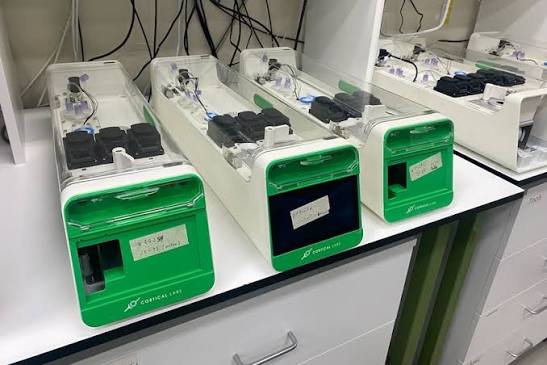
The work is being developed by Melbourne-based biotechnology company Cortical Labs, which created the CL1, a commercially available biological computer that integrates living neurons with silicon hardware. The system is designed to keep the neurons alive while allowing software and researchers to communicate with them in real time.
The neurons used by the system can be produced from induced stem cells generated from donated blood. These cells are transformed into neurons and grown over a silicon chip containing an array of electrodes. The chip can send electrical signals into the neural network and record the electrical activity produced by the cells in response.
The concept builds on Cortical Labs' earlier DishBrain experiments, in which researchers connected biological neurons to a simulated environment and taught them to play the classic video game Pong. The neurons were provided with information about the game and feedback about their actions, allowing the biological network to adapt its activity over time.
Cortical Labs describes this approach as Synthetic Biological Intelligence, or SBI. The idea is different from conventional artificial intelligence, which attempts to reproduce aspects of biological intelligence using mathematical models running on computer hardware. Biological computing instead uses actual living neural networks as part of the information-processing system.
The potential advantages are attracting interest because biological neurons operate very differently from conventional silicon processors. Cortical Labs says its CL1 systems require only a few watts of power and can maintain living neurons for up to six months using an integrated life-support system. Researchers are investigating whether biological systems could eventually provide energy-efficient approaches to certain computing and AI problems.
The technology is also being explored beyond artificial intelligence. Researchers see potential applications in drug development, disease modelling and neuroscience because the system provides an opportunity to study how real human neurons respond to different substances and conditions. In 2025, researchers using the technology reported experiments examining how neurological disease models responded to drug treatment.
The technology has continued to expand in 2026. Cortical Labs launched a biological data centre in Melbourne containing 120 CL1 systems, with each device containing approximately 200,000 neurons. The company says the facility is intended to give researchers and developers access to biological computing on a larger scale.
Researchers have also demonstrated that the biological systems can be used for more complex tasks. In 2026, Australian researchers trained laboratory-grown brain cells connected to silicon hardware to play the classic first-person shooter Doom, showing that the technology is moving beyond the earlier Pong experiments.
Despite the science-fiction appearance of the technology, the systems remain highly limited compared with a human brain. The neurons do not constitute a complete brain, and the technology should not be confused with a conscious artificial person. Scientists are instead studying whether the adaptive properties of biological neural networks can provide useful forms of computation that complement or eventually improve conventional AI systems.
The emergence of biological computers represents a significant shift in how researchers think about artificial intelligence. Rather than attempting to make machines increasingly resemble biological intelligence through software alone, scientists are beginning to incorporate biological intelligence itself into computing systems. If the technology can be scaled reliably, it could open a new field in which silicon hardware, software and living cells work together to process information.