China vs US: The AI Race Is About More Than Just Chatbots
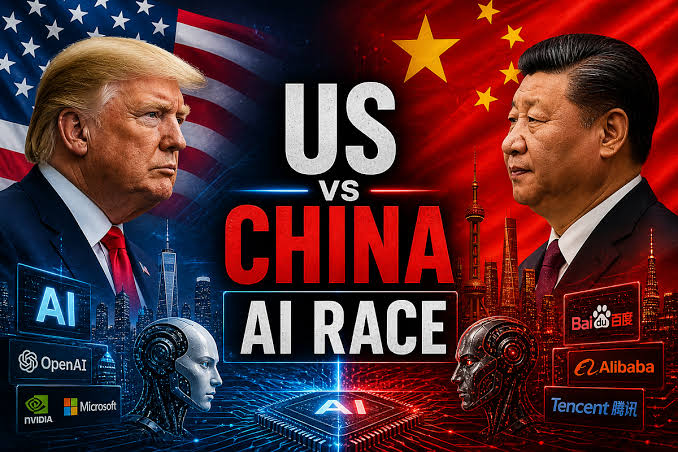
The United States and China are competing intensely to develop the next generation of artificial intelligence. But measuring the competition is not as simple as asking which country has the “best AI.”
The two countries have different strengths. The United States has a major advantage in computing infrastructure, investment and the development of leading frontier models. China has built a huge research base, is producing large numbers of AI specialists and has rapidly narrowed the gap in model performance.
The result is an AI race with no single scoreboard.
Computing Power: The US Has a Major Infrastructure Advantage
Modern AI depends heavily on computing power. Training an advanced AI model can require enormous numbers of specialized processors running together in large data centres.
One of the biggest companies in this part of the US ecosystem is Nvidia, whose GPUs are widely used to train and run AI models. Other major American technology companies, including Microsoft, Google, Amazon and Meta, are investing heavily in data centres and AI infrastructure.
The United States has a substantial share of the world's AI computing capacity. Nvidia alone accounts for more than 60 percent of global AI compute among major chip designers, according to the 2026 Stanford AI Index.
The US advantage is not just about individual chips. Companies such as Microsoft, Amazon and Google operate enormous cloud-computing platforms, while companies such as OpenAI, Anthropic and xAI use large-scale computing infrastructure to develop and deploy advanced AI systems.
China is building its own ecosystem. Huawei is one of its most important semiconductor and computing companies, while Alibaba Cloud, Tencent Cloud and Baidu provide major cloud and AI services.
China also has AI companies such as DeepSeek, Alibaba and Z.ai developing increasingly capable models.
China faces restrictions on access to some of the world's most advanced AI chips while developing domestic alternatives. Chinese companies are therefore investing heavily in local computing infrastructure and semiconductor technology.
AI Models: China Has Rapidly Narrowed the Gap
For years, leading US laboratories were clearly ahead in frontier AI models.
Companies such as OpenAI, Google DeepMind, Anthropic and xAI have developed some of the most prominent AI systems, including GPT, Gemini, Claude and Grok.
That gap has narrowed considerably.
Chinese companies such as DeepSeek, Alibaba, Z.ai and Tencent have produced models capable of competing with leading US systems on a growing range of tasks, including coding, reasoning and AI-agent work.
Stanford's 2026 AI Index found that US and Chinese models have repeatedly exchanged positions near the top of performance rankings. By March 2026, the leading US model had only a 2.7 percent advantage over the leading Chinese model in the measured comparison.
That does not mean the models are identical. Performance can vary depending on the task, benchmark, cost and whether a model is open-weight or closed.
Current usage data also presents a complicated picture. Chinese models such as DeepSeek, GLM and Tencent models receive substantial usage, while major US models from companies such as Anthropic and OpenAI also remain heavily used.
One reason Chinese models have gained attention is cost. Several Chinese companies have released open-weight models, allowing developers to download and adapt them rather than relying entirely on a company's hosted service.
The important change is that China has moved much closer to the US frontier.
Money: The US Is Investing Enormous Amounts
Building AI at scale requires more than talented researchers. Companies need chips, data centres, electricity, networking equipment and cloud infrastructure.
Here the US has a huge financial advantage.
The American AI ecosystem includes some of the world's largest technology companies. Amazon, Microsoft and Google operate enormous cloud businesses, while Meta and Oracle are also investing heavily in computing infrastructure. Nvidia supplies much of the specialized hardware required by these AI systems.
Goldman Sachs estimates cited by Al Jazeera indicate that major US hyperscalers are expected to spend about $764 billion in 2026. The companies included in the estimate are Amazon, Microsoft, Google, Meta and Oracle. By comparison, Alibaba, Tencent, Baidu and ByteDance are expected to spend about $102 billion.
China's technology sector is also spending heavily. Alibaba is investing in cloud computing and its Qwen AI family, Tencent is developing AI through its Hunyuan models and cloud infrastructure, Baidu is developing its ERNIE AI systems, and ByteDance is investing in AI products and infrastructure.
China's spending is growing rapidly, but the absolute scale of US investment remains much larger. Stanford's 2026 AI Index also reports that US private AI investment continues to substantially exceed China's.
Research: China Produces More AI Research
China's strongest advantage appears in research output.
According to figures cited from Georgetown University's Center for Security and Emerging Technology, China accounted for more than 27 percent of global AI publications in 2024, compared with about 12 percent for the United States.
China's research ecosystem includes major technology companies such as Baidu, Alibaba, Tencent and Huawei, as well as universities and independent AI laboratories.
In the US, companies including Google DeepMind, Microsoft, OpenAI, Meta, Anthropic and Amazon are major contributors to AI research and development.
Stanford's 2026 AI Index reports that China leads the US in publication volume, citations and patent grants, while the US remains ahead in the production of notable AI models.
In 2025, the report counted 59 notable AI models from the US compared with 35 from China.
This distinction is important.
Publishing more research does not automatically mean producing the most powerful commercial AI systems. Research quantity, research impact, engineering ability, computing resources and successful product development are different measurements.
Talent: China Trains More, While the US Attracts Researchers
AI development ultimately depends on people.
China has dramatically expanded its AI education and research capacity. Major companies such as Alibaba, Tencent, Baidu and Huawei employ large numbers of engineers and researchers, while Chinese universities continue to produce AI specialists.
Research cited by the National Academies found that China accounted for 47 percent of the world's top AI talent by undergraduate origin in 2022, up from 29 percent in 2019.
But there is another side to the story.
Many researchers educated in China work outside China, particularly in the United States. This means that a country's ability to produce AI talent and its ability to retain that talent are not the same thing.
The United States has attracted large numbers of highly skilled researchers from around the world. Companies such as Google, Microsoft, OpenAI, Meta, Anthropic and Nvidia compete for this talent alongside major universities and research institutions.
The Bigger Picture
The four measurements tell four different stories.
The US has a major advantage in AI computing infrastructure and investment.
China has a major advantage in research volume and is rapidly expanding its technical talent base.
In frontier AI models, the gap has become much smaller than it was several years ago.
That makes the AI competition increasingly difficult to describe with a single winner.
The more important question is what happens next.
If computing power remains the biggest constraint, the US's enormous investment by companies such as Microsoft, Google, Amazon, Meta and Nvidia could remain important.
If efficiency becomes more important, China's ability to produce capable models at lower costs could become increasingly valuable. Companies such as DeepSeek, Alibaba, Tencent and Baidu are important examples of China's growing AI ecosystem.
Research and talent could also determine what happens over the longer term. China is producing huge amounts of AI research and training large numbers of specialists, while the US continues to attract researchers and combine them with enormous private-sector investment.
What Should Be the Outcome?
The future of the AI race will probably depend less on who has the biggest model today and more on who can continuously improve its technology.
The country that can successfully combine advanced chips, computing infrastructure, research, skilled engineers, investment and real-world AI adoption will have important advantages.
The US has companies such as Nvidia, Microsoft, Google, Amazon, Meta, OpenAI and Anthropic covering different parts of this ecosystem.
China has companies such as Huawei, Alibaba, Tencent, Baidu, ByteDance, DeepSeek and Z.ai building its own competing ecosystem.
The US-China AI competition is therefore no longer simply about building the smartest chatbot.
It is becoming a competition over the entire AI ecosystem — chips, computing power, research, talent, money, software and real-world adoption.
And that is what makes the US-China AI race one of the most important technology stories of this decade.