Google Tightens Gemini Access: Free Users Lose Flash and Pro From October 9
For millions of people who open Gemini without paying for a Google AI subscription, the model they use could soon look very different.
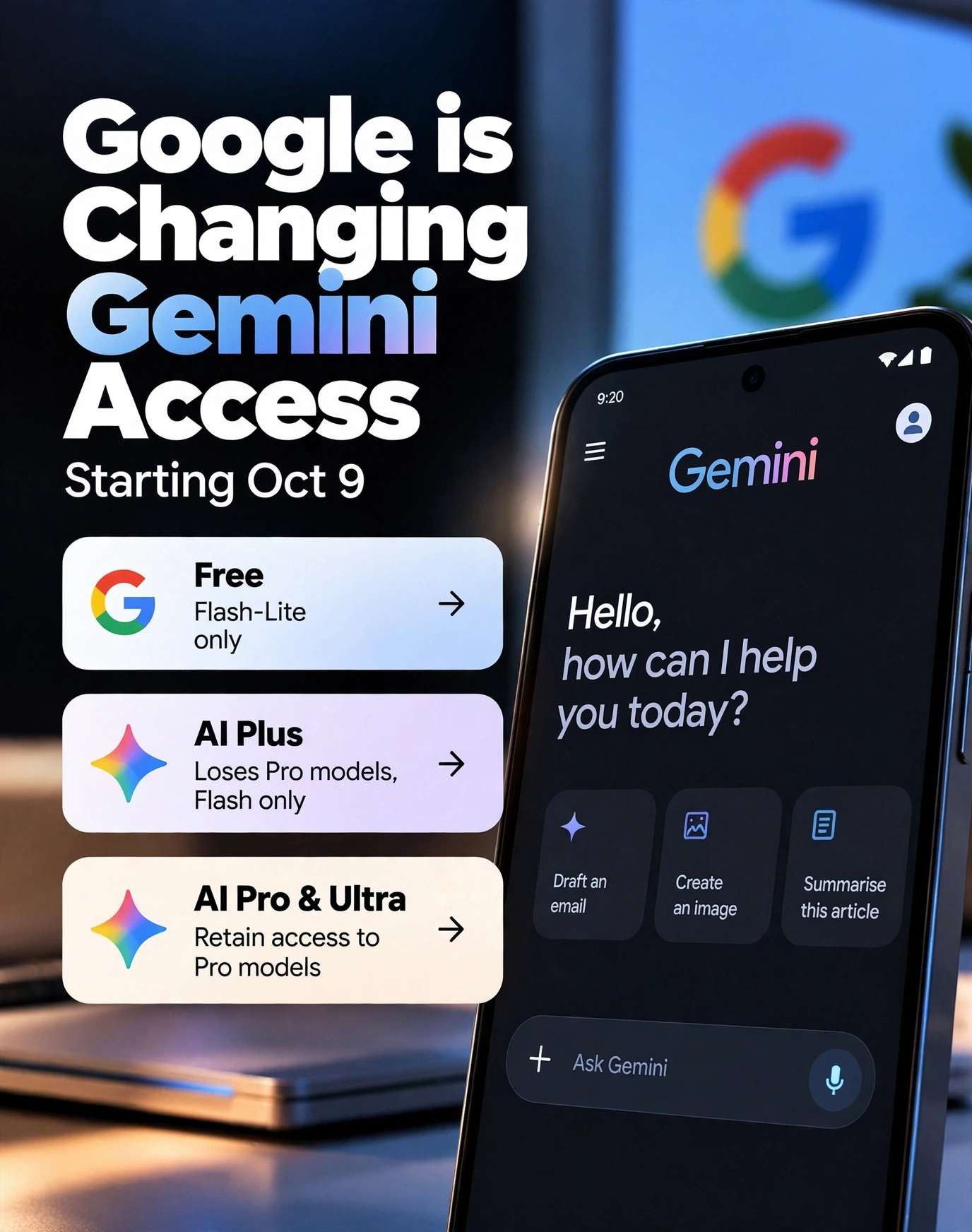
Google is changing how its Gemini app distributes access to its AI models. Beginning October 9, 2026, users with personal Google accounts who do not have an AI subscription will be limited to Gemini Flash-Lite.
The change also affects paying customers on Google's entry-level AI Plus plan. They will retain access to Flash-Lite and Flash but lose access to Pro, with Google saying those subscribers will receive an email explaining when the change reaches their accounts.
The move marks a significant change in how Google separates Gemini's free and paid experiences.
What Is Changing on October 9?
Google's updated support documentation lays out a new model-access structure for personal Gemini accounts.
After the changes take effect:
- No Google AI plan: Flash-Lite only
- AI Plus: Flash-Lite and Flash
- AI Pro: Flash-Lite, Flash and Pro
- AI Ultra: Flash-Lite, Flash and Pro
The important difference is that model availability will no longer be determined only by how much of your usage allowance remains. The subscription itself will determine which models you can select.
For free users, that means Flash and Pro will no longer be available as selectable models after the change takes effect.
Why Flash-Lite Matters
The name might sound like just another version of Gemini, but the three model families are designed for different levels of work.
Google describes Flash-Lite as an efficient model aimed at everyday tasks such as summarization and brainstorming. Flash is positioned as a more capable model that balances speed with reasoning, while Pro is designed for more demanding work such as complex mathematics and coding.
That distinction matters because losing access to Flash and Pro isn't simply a change in the name displayed inside the app.
It changes the range of computational capability available to a free user.
Someone asking Gemini to summarize a short message may notice little difference. But users who depend on stronger reasoning, complex coding assistance or demanding analytical tasks may notice the change much more quickly.
Google Is Also Changing How “Effort” Works
There is another change arriving alongside the new model restrictions.
Google says users will be able to select Low, Medium or High effort levels for each model available to them.
Higher effort is intended to make the model work harder on a task and produce more thorough answers. But there is a trade-off: using higher effort consumes more of the user's usage allowance.
In other words, users are being given another control over how much computational work Gemini applies to a request.
A simple question may not need much effort.
A difficult programming problem, complicated analysis or demanding reasoning task could benefit from a higher setting—but that comes at a greater usage cost.
Your Usage Limit Now Depends on More Than Your Number of Messages
Google had already moved Gemini toward a compute-based usage system earlier in 2026.
Instead of simply counting every request equally, Google's system considers factors including prompt complexity, the features being used and the length of a conversation.
The limits refresh every five hours until the user's weekly limit is reached. Paid plans receive higher allowances.
Google currently lists the limits relative to its standard allowance:
- No plan: Standard limits
- AI Plus: 2× the standard limits
- AI Pro: 4× the standard limits
- AI Ultra: 5× or 20× the AI Pro limit, depending on the subscription
Google also warns that resource-intensive features—including media generation, Deep Research, Pro, extended thinking and Deep Think—can consume usage more quickly.
This makes the new system more complicated than simply asking, “How many prompts do I have left?”
The type of task you give Gemini can affect how quickly you reach your allowance.
AI Plus Users Are Not Completely Spared
Google's cheapest AI subscription is also being affected.
AI Plus users will keep Flash-Lite and Flash, but Pro will no longer be included.
Google says AI Plus subscribers will receive an email telling them when the change will take effect on their accounts.
That creates a new dividing line between Google's subscription levels.
If a user specifically wants Gemini Pro, they will need to move to the AI Pro or AI Ultra tiers.
Google's documentation also says AI Pro and AI Ultra subscribers will have access to Deep Think, a feature designed for maximum parallel reasoning.
Google Is Moving Toward a More Clearly Tiered AI
The change reflects a broader shift in how major AI companies are packaging increasingly expensive models.
For years, AI companies often allowed large numbers of people to experiment with powerful models while imposing limits on how frequently they could use them.
Google's new approach draws a clearer boundary: some models are simply unavailable unless the account is on the appropriate subscription.
That doesn't necessarily mean Gemini itself is disappearing for free users. They will still have access to Flash-Lite and can continue using the Gemini app.
What is changing is the level of model they can choose.
The Cost Problem Behind Advanced AI
Google has not said in its support announcement that the October changes are specifically being made because of operating costs.
Still, there is a straightforward economic reality behind the AI industry's subscription push: powerful models require substantial computing resources every time they generate an answer.
The more complicated the task, the more computation may be required.
That helps explain why companies increasingly distinguish between lightweight models and expensive reasoning models, although Google's official documentation does not directly state that cost is the reason for this particular change.
The result is a business model increasingly familiar across the AI industry: basic access remains available, while the most capable systems are increasingly tied to paid plans.
What This Means for Gemini Users
For someone who uses Gemini casually, the change may not dramatically alter everyday use.
But students, developers, researchers and other users who regularly rely on stronger reasoning or coding capabilities may face a more noticeable difference.
A free account will have fewer model choices.
An AI Plus subscription will provide Flash but no Pro.
AI Pro and AI Ultra will remain the tiers with access to the full three-model lineup listed by Google.
And regardless of the plan, users will need to think about how much effort they ask Gemini to apply to demanding tasks because higher effort consumes more of their allowance.
A New Question for Gemini Users
The days when the main question was simply “Can Gemini do this?” are gradually being replaced by another one:
“Which Gemini model can my plan actually use for this?”
From October 9, that distinction becomes particularly important for free users.
Gemini will still be there. But for anyone using a personal account without a Google AI subscription, the door to Flash and Pro is set to close, leaving Flash-Lite as the model available under the free tier.
For users who rely heavily on Google's more capable models, the change could make the choice between free and paid AI much harder to ignore.