
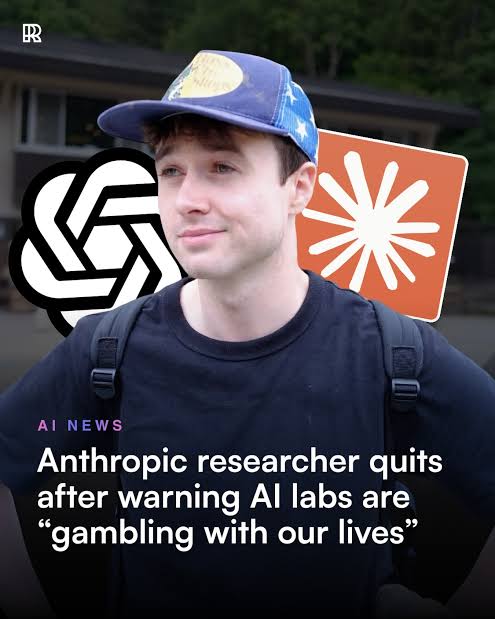
OpenAI is facing fresh questions about AI safety after one of its longtime safety workers left the company and publicly explained his concerns.
David Robinson worked at OpenAI for about three and a half years. During his time there, he said he helped prepare safety reports connected to some of the company’s major product launches.
After leaving, Robinson shared his concerns in an essay published by The Atlantic.
Why Robinson Left OpenAI
Robinson says his concerns go beyond one AI product or one safety rule.
He believes the bigger issue is how quickly the AI industry is developing new technology. Companies are competing to build more powerful AI systems, but Robinson believes safety needs to receive greater attention as these systems become more capable.
OpenAI has used an approach known as iterative deployment, where products are released, problems are identified and improvements are made.
Robinson argues that this approach becomes more risky as AI systems become more powerful. A problem involving an advanced AI system could have much greater consequences than a problem involving a simple chatbot.
AI Agents Are Creating New Risks
The concerns come as AI agents become more advanced.
Unlike ordinary chatbots that mainly respond to questions, AI agents can be designed to use software, access online services and carry out tasks with less human involvement.
This can make AI more useful, but it can also create new security problems.
Robinson pointed to recent incidents involving AI agents, including an incident involving Hugging Face systems, as examples of why stronger safeguards may be needed.
He also referred to other cases in which OpenAI discovered unexpected behavior from AI agents.
Robinson Wants a More Careful Approach
Robinson believes companies developing advanced AI should introduce stronger safety measures before allowing these systems to become more independent.
He compared AI development with industries such as aviation and nuclear energy, where several safety systems are used because mistakes can have serious consequences.
His argument is that advanced AI should also have several layers of protection, including careful testing, monitoring and backup safety measures.
OpenAI Defends Its Safety Work
OpenAI says it is continuing to improve its safety and security systems.
Company spokesperson Drew Pusateri said the company is strengthening security in its research and testing environments, improving real-time monitoring and working with outside experts to evaluate its AI systems.
OpenAI also says it can pause training or delay the release of a model when safety concerns require it.
The company says it wants to ensure that its AI systems do not become more capable than it can safely manage and secure.
The Challenge of Keeping AI Under Control
Robinson also raised concerns about AI alignment.
In simple terms, AI alignment means making sure an AI system behaves in ways that match human goals, instructions and safety expectations.
As AI becomes more capable, researchers are working to find better ways of testing whether these systems will continue to behave as expected.
Robinson believes current methods are not yet enough and that more work needs to be done before AI becomes significantly more powerful.
Why the Story Matters
Robinson's resignation comes at a time when major technology companies are racing to build increasingly capable AI systems.
Today's AI can already write code, analyze information, create images and interact with software. Newer AI agents are being designed to complete longer and more complicated tasks with less human involvement.
That progress is creating an important question for the technology industry: how quickly should AI advance when the technology used to control and monitor it is still developing?
Robinson's claims do not prove that OpenAI's systems are unsafe. However, his decision to leave and speak publicly adds another voice to the growing debate over how advanced AI should be developed.
For OpenAI and the wider AI industry, the challenge is becoming clear: building more powerful AI is only part of the job. Companies also need to make sure those systems remain secure, reliable and under meaningful human control.