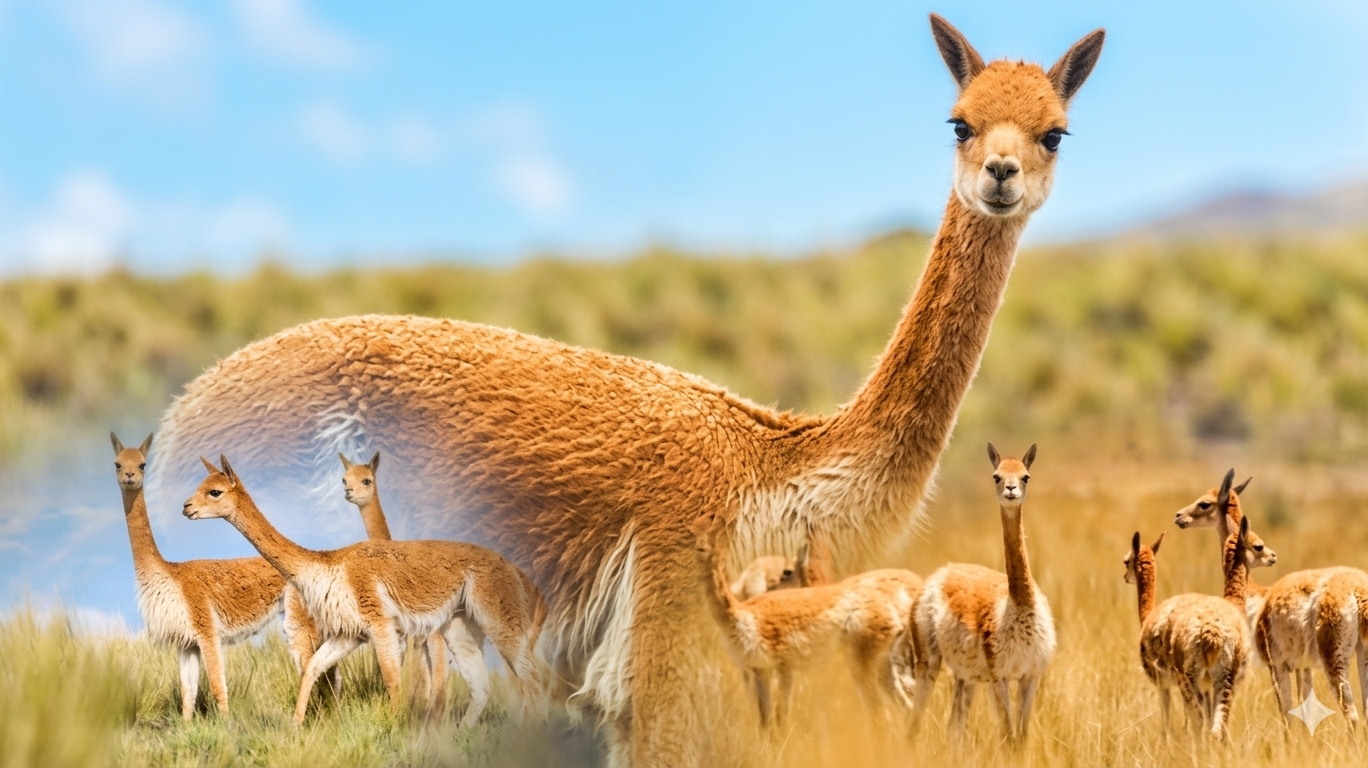
At first, the animal looks almost too delicate for the mountain.
A slender body, long legs, a small face watching from the cold, empty heights of the Andes. This is the vicuña, a wild relative of the llama and alpaca that lives high in South America. For centuries, people have valued it for its incredibly fine wool. But in the high Andes of Peru, scientists are discovering another reason this little animal matters.
Follow a vicuña across land recently abandoned by a retreating glacier, and you may find something unexpected behind it, dung!
Small piles of it gather on the bare ground, forming communal latrines. Around some of these spots, life is beginning to return. Plants are finding a place to grow. Microbes are moving through the soil. Nutrients are accumulating where there was once little to support life.
It sounds almost ridiculous. How could an animal that weighs only a fraction of what a glacier weighs possibly help rebuild a landscape left behind by melting ice? But that is exactly what makes the vicuña's story so fascinating.
The glaciers of the tropical Andes are shrinking. The IPCC reports that the region has lost about 30% or more of its glacier area since the 1980s. As the ice retreats, it exposes land that can be extremely difficult for plants to colonise. There is little organic material, little moisture, and few nutrients. The glacier leaves. Life has to figure out how to follow.
That is where the vicuña comes in.
Researchers studying two glaciers in Peru, Puca and Osjollo Anante, noticed that vicuñas were leaving behind communal piles of dung, known as latrines, on land that had recently been exposed by retreating ice. These were not ordinary piles of animal waste. The soils around the latrines were packed with ingredients that young ecosystems need.
In the study, published in Scientific Reports, soil from vicuña latrines contained an average of 62% organic matter. Nearby moraine soils that had been exposed for about 85 years contained only around 1.5% total organic carbon. The latrine soils also held more moisture and nutrients and supported richer microbial communities.
Think of the vicuña as a tiny mountain courier. It feeds in places where plants and nutrients are already available. Then it moves across the landscape and leaves some of those nutrients behind in concentrated spots. Its dung becomes a delivery system. Instead of waiting for a barren landscape to slowly collect everything it needs, the animal helps bring some of those ingredients in.
The effect does not happen overnight. But it can change the starting point for life.
Some of the vicuña latrines studied by researchers had remained in the landscape for at least 11 years. Around them, scientists found signs of greater biological activity and plant cover. Their findings suggest that vicuña activity can speed up soil development and primary succession, potentially shortening a process that might otherwise take more than a century.
That makes the animal's story even more surprising. Humans once came dangerously close to removing the vicuña from this landscape altogether. Its incredibly fine wool made it valuable, and uncontrolled hunting pushed wild populations to only a few thousand by the 1960s. In 1975, the species was placed in Appendix I of CITES, giving it the highest level of protection under the convention. Later, conservation efforts in countries such as Peru and Bolivia included community-based management and the traditional Chaku, in which wild vicuñas are captured, shorn and released.
Today, the vicuña is classified as Least Concern by the IUCN, although illegal trade remains a threat.
There is something almost poetic about what happened next. An animal once hunted for what could be taken from its body is now being studied for what it gives back to the land. That is poetic, don't you think?
The glaciers will continue to retreat as the climate warms. Vicuñas cannot stop that. They cannot bring the ice back. But as the glacier frontier moves higher, these animals are already walking across the ground it leaves behind. And wherever they stop, they may be leaving more than dung. They may be leaving the first ingredients for whatever grows there next.