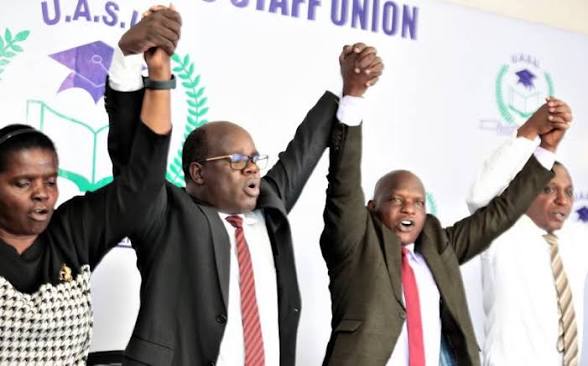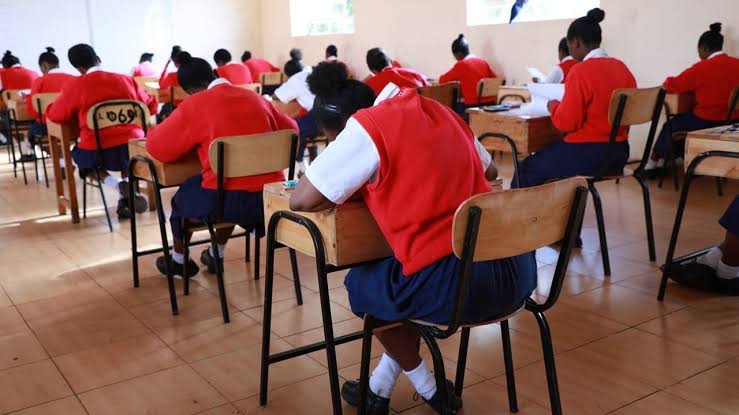
ilence has replaced the usual bustle across Kenya’s public universities as the nationwide lecturers’ strike enters its second week, leaving lecture halls deserted and over 300,000 students stranded across the country. The industrial action, spearheaded by the Universities Academic Staff Union (UASU) and the Kenya University Staff Union (KUSU), has completely paralyzed operations at major institutions including Moi University, Kenyatta University, and the University of Nairobi. At the heart of the gridlock is the government’s failure to implement the 2025–2029 Collective Bargaining Agreement (CBA), alongside fierce union opposition to the current university funding model. "We will not return to the classrooms on empty promises," stated UASU Secretary-General Constantine Wasonga, insisting that a concrete, exchequer-backed financing framework must be signed before any return-to-work formula is considered. While Education Cabinet Secretary Julius Migos Ogamba has convened an emergency inter-ministerial committee alongside National Treasury Cabinet Secretary John Mbadi to unlock the financial stalemate, union leaders have urged their members to ignore court orders suspending the strike. The government previously offered a Sh9.76 billion allocation toward the pay package, but union leadership rejected this figure out of hand, terming it insufficient to cover the broad cost-of-living adjustments, car loans, and medical schemes included in the original framework. Beyond the direct salary increment, the stalemate highlights a fundamental philosophical split over how public higher education is funded in Kenya, with striking unions demanding a total overhaul of the proposed loan-based student financing architecture. Under the current state plan, public universities rely heavily on disbursed student tuition fees and individualized loans to cover operational costs, a system that union branches from smaller institutions argue actively punishes younger universities with lower student enrolment. "We refuse to have our payrolls tied to school fees collections; university staff salaries must be handled as a centralized, non-negotiable exchequer expense, just like any other department of the public service," insisted regional union officials. While the legal and economic standoffs play out in closed-door government boardrooms, the visible consequences remain on campus where academic calendars have completely derailed, forcing tens of thousands of local and international students into an unplanned limbo. Final-year students, many of whom have already paid graduation fees and made logistical arrangements for their families, express severe anxiety over missed employment windows and indefinite graduation delays, yet as long as faculty refuse to pick up the chalk, public university campuses nationwide remain functionally frozen.
LECTURERS STRIKE WAGES ON
The industrial action, spearheaded by the Universities Academic Staff Union (UASU) and the Kenya University Staff Union (KUSU), has completely paralyzed operations at major institutions including Moi University, Kenyatta University, and the University of Nairobi [1]. At the heart of the gridlock is the government’s failure to implement the 2025–2029 Collective Bargaining Agreement (CBA), alongside fierce union opposition to the current university funding model. "We will not return to the classrooms on empty promises," stated UASU Secretary-General Constantine Wasonga, insisting that a concrete, exchequer-backed financing framework must be signed before any return-to-work formula is considered. While Education Cabinet Secretary Julius Migos Ogamba has convened an emergency inter-ministerial committee to unlock the stalemate, union leaders have urged their members to ignore court orders suspending the strike. As the "make-or-break" talks continue behind closed doors, final-year students face growing anxiety over disrupted academic calendars and indefinitely delayed graduations.